Snapdragon vs MediaTek vs Exynos: Which Phone Processor Is Better?
Snapdragon, MediaTek or Exynos? Compare performance, gaming, battery life, cameras, heat and value to find the right phone processor for you.

Every phone buyer eventually hits the same wall. You find a phone you like, the price is right, the camera looks good, and then you notice the processor name: Snapdragon, Dimensity, Exynos. Someone in the comments says one of them is "trash," another friend swears by a different one, and you are left more confused than before.
The truth is less dramatic than the internet makes it sound. All three brands make capable chips, and all three make weaker ones too. What matters is which chip sits inside the phone you are actually considering, and what you plan to do with it. This guide explains the real differences in plain language so you can choose with confidence.
Table of Contents
What a Phone Processor Actually Does
The processor, usually called a chipset or SoC (system on a chip), is the brain of your phone. It is not just a CPU. One small piece of silicon holds the main processor cores, the graphics unit (GPU), the AI engine (NPU), the image signal processor that handles your photos, the modem that connects you to 4G and 5G, and the parts that manage Wi-Fi, Bluetooth and charging behaviour.
That is why the chipset affects almost everything you notice day to day: how quickly apps open, how smooth games feel, how well the phone holds a call signal, how long the battery lasts, and how good your photos and videos look after processing.
Meet the Three Brands
Snapdragon (Qualcomm)
Qualcomm is an American company and its Snapdragon chips are the most widely recognised in the Android world. You will find them in flagships like the Samsung Galaxy S series in many markets, plus phones from Xiaomi, OnePlus, Oppo, Vivo, Honor, Motorola and others. Snapdragon covers everything from the budget-friendly 4 and 6 series up to the premium 8 series, with the 8 Elite class sitting at the very top.
MediaTek (Dimensity and Helio)
MediaTek is a Taiwanese company that spent years being seen as the "budget chip" maker. That reputation is out of date. Its Dimensity line, especially the 9000 series, now competes directly with the best Snapdragon chips, and the mid-range Dimensity 7000 and 8000 series are very popular in value-focused phones from brands like Infinix, Tecno, Realme, Poco and Vivo. The older Helio name still appears on entry-level phones.
Exynos (Samsung)
Exynos is Samsung's own chip family. Samsung uses it in selected models and regions, mostly in its Galaxy S, Galaxy Z and Galaxy A phones. Exynos has had a rocky past, with heat and efficiency complaints in earlier generations, but recent versions have narrowed the gap considerably. Since Samsung designs and builds the phone and the chip together, there is a nice level of software integration when it works well.
Performance: Who Is Faster?
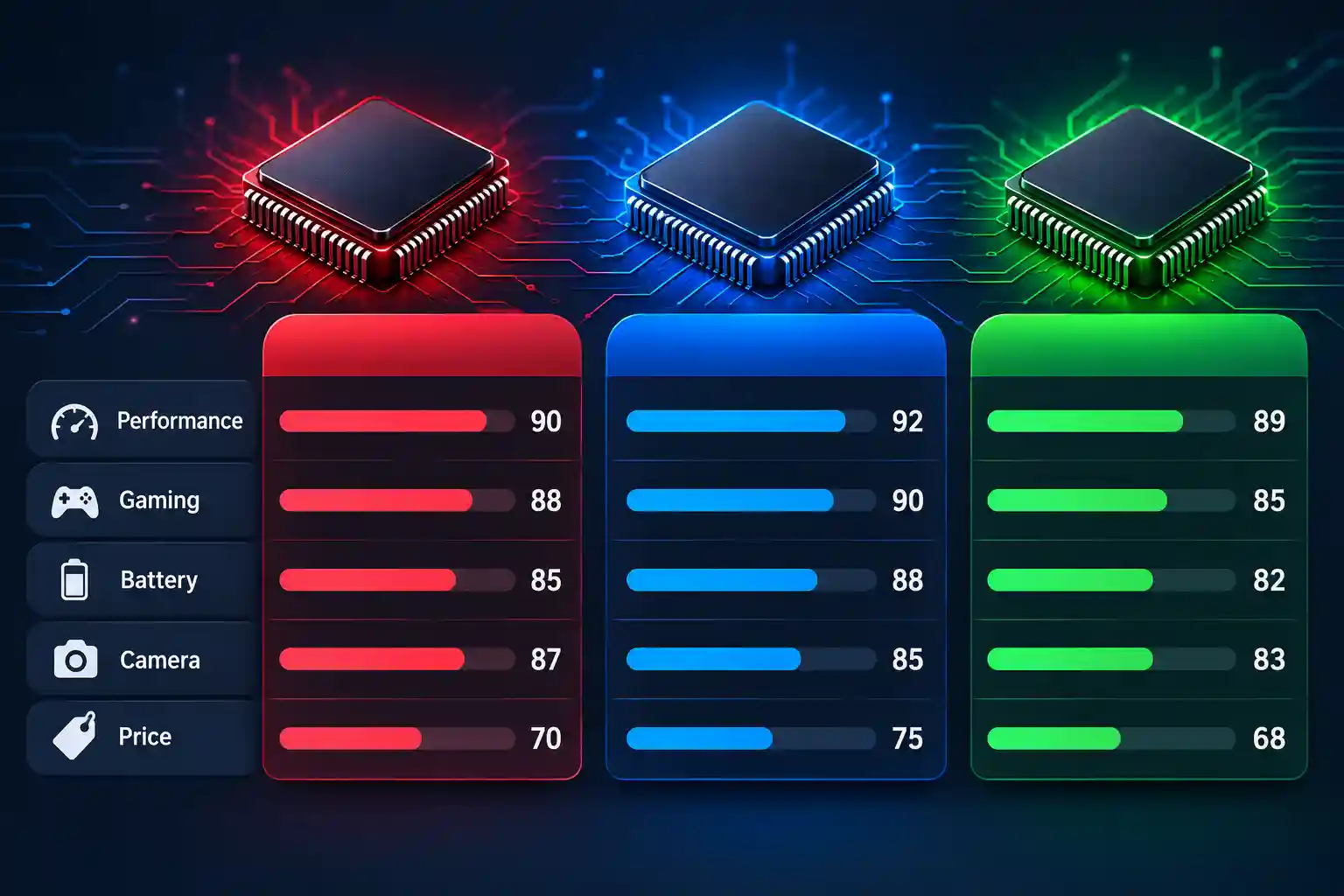
If you only look at raw speed, the top Snapdragon and top Dimensity chips are extremely close, and both sit at the front of the pack. Exynos flagships are usually a small step behind in sustained performance, although the difference is not something most people will feel while browsing, messaging or watching videos.
Here is a fair way to think about it:
- Flagship tier: Snapdragon 8 series and Dimensity 9000 series trade blows. Which one "wins" depends on the specific generation and the test.
- Upper mid-range: Snapdragon 7 series and Dimensity 8000 series offer excellent real-world speed for a much lower price, and this is where MediaTek often delivers more performance per rupee.
- Budget tier: Snapdragon 4 and 6 series, Dimensity 6000 series and Helio chips all handle daily tasks well, but they will slow down with heavy multitasking.
A word of warning about benchmark scores: they are useful for a rough comparison, but they do not tell the whole story. A chip that scores high for ten seconds and then throttles after ten minutes is not better than a slightly slower chip that stays steady.
Gaming: Smooth Frames and Stable Performance
Gamers care about two things: frame rate and consistency. Snapdragon's Adreno graphics have long been the safest choice here. Game developers optimise heavily for them, so titles like PUBG Mobile, Call of Duty Mobile, Genshin Impact and Free Fire usually run well and unlock their highest settings without fuss.
MediaTek has made big progress. Its recent Dimensity chips with strong GPUs and gaming-focused technology can hold high frame rates for long sessions, and several gaming phones now use them. Where MediaTek phones sometimes lose points is not the chip but the tuning, since each brand decides how aggressively to cool and throttle the phone.
Exynos gaming has improved, particularly with newer Samsung graphics designs, but it is still the least common choice among serious mobile gamers.
If gaming is your priority, look beyond the chip name. Check the cooling system, the display refresh rate and touch sampling rate. A well-cooled Dimensity phone can easily beat a poorly cooled Snapdragon phone.
Battery Life and Heat
Efficiency is where manufacturing matters. A chip built on a more advanced process uses less power for the same work, and that means cooler temperatures and longer battery life.
Snapdragon and Dimensity flagships built on the latest processes are very efficient. Older Exynos chips earned a reputation for running warm and draining quicker, and some of that criticism was fair. Newer Exynos generations are better, but if battery life is your top concern, it is still wise to read battery tests for the exact phone before buying.
A useful rule: do not judge battery life from the chip alone. Battery capacity, display type, software optimisation and charging speed all play a big part. Our guide on AMOLED vs LCD displays explains how your screen choice affects daily battery use too.
Camera and AI Features
The chipset's image signal processor handles things like HDR, night mode, video stabilisation and noise reduction. Qualcomm has strong camera processing and often supports advanced features like high-quality 8K video and fast autofocus across multiple lenses. MediaTek has also improved a lot, with strong support for high-megapixel sensors and low-light video.
However, camera quality depends heavily on the brand's software and tuning, not just the chip. The same chipset can produce very different photos in two different phones. That is why a mid-range phone with great tuning can out-shoot a more powerful phone with average tuning.
On AI, all three brands now build dedicated AI engines for features such as on-device translation, photo editing, voice tools and smart assistants. Snapdragon and Dimensity flagships currently lead on the heavier on-device AI tasks, while Exynos covers most of the common features found in Samsung's Galaxy AI tools.
5G and Connectivity
The modem inside the chipset decides how well your phone holds a signal, how fast it downloads, and how much battery it uses while online. Qualcomm has traditionally been admired for its modems, especially for reliable performance in weak coverage areas. MediaTek's modems are strong on the newer chips and perform well in most places. Exynos modems are generally decent but vary more by generation.
Because 5G support and band availability differ by country and carrier, always check that the phone supports the networks in your region. This matters especially if you plan to import a phone or buy a model made for another market.
Software Updates and Long-Term Support
The chipset can influence how long a phone receives updates. Qualcomm has promised longer update support on some of its recent platforms, but the real commitment still comes from the phone brand. Samsung, for example, offers long update support across its range regardless of whether a model uses Exynos or Snapdragon. Always check the update promise of the specific phone, not just the processor.
Quick Comparison Table
|
Feature |
Snapdragon |
MediaTek |
Exynos |
|---|---|---|---|
|
Flagship performance |
Excellent |
Excellent |
Very good |
|
Mid-range value |
Very good |
Excellent |
Good |
|
Gaming |
Excellent, widely optimised |
Very good, improving fast |
Good |
|
Battery efficiency |
Very good |
Very good |
Good, improving |
|
Camera processing |
Excellent |
Very good |
Very good |
|
Modem and signal |
Excellent |
Very good |
Good |
|
Availability |
Very wide |
Very wide |
Limited to Samsung |
Which Processor Should You Choose?
Instead of picking a brand, pick based on how you use your phone.
For heavy gaming: Choose a Snapdragon 8 series or a high-end Dimensity chip, and pay attention to cooling and a high refresh rate display.
For best value under a tight budget: Look closely at Dimensity phones. MediaTek often packs more speed and features into lower prices, which is why many popular budget and mid-range phones use it.
For all-round reliability and camera quality: A Snapdragon phone is a safe choice, especially from a brand with a good reputation for software.
For a Samsung experience: An Exynos-powered Galaxy can be a good phone, but check reviews for your specific model and region to make sure heat and battery life meet your standards.
For everyday users: Honestly, almost any modern chip from these three brands will handle social media, video calls, browsing and streaming without trouble. You will get more from choosing a good display, enough RAM and a reliable brand than from chasing the "best" chip.

Common Myths About Phone Processors
"MediaTek is always worse than Snapdragon." This was somewhat true years ago. Today the best Dimensity chips compete with top Snapdragon chips, and in the mid-range MediaTek often wins on value.
"Exynos is always bad." Earlier generations had real issues, but newer ones have improved. Judge the specific chip, not the reputation.
"A higher benchmark score means a better phone." Benchmarks measure short bursts of raw power. Real life depends on cooling, software, battery and display too.
"You need a flagship chip for a smooth phone." Not at all. A well-optimised mid-range phone can feel just as smooth for everyday use.
Final Verdict
There is no single winner in the Snapdragon vs MediaTek vs Exynos debate. Snapdragon is the most polished all-rounder, especially for gaming, cameras and signal quality. MediaTek is the value champion and has become a true flagship competitor. Exynos is a decent choice inside Samsung phones and keeps getting better, but it needs a closer look before you buy.
Before you decide, read reviews of the exact phone, check temperature and battery tests, and compare the full specifications rather than the chip name alone. You can use the MobileListify comparison tool to place two phones side by side and see exactly how their processors, displays, cameras and batteries stack up.
The best processor is the one that fits your budget and your habits. Choose the phone first, check how its chip behaves in real tests, and you will end up with a device you enjoy using for years.
FAQs
Is Snapdragon better than MediaTek?
At the very top, they are close rivals. Snapdragon is usually more widely optimised for games and apps, while MediaTek often gives better value in mid-range phones.
Is Exynos good for gaming?
Recent Exynos chips handle popular games well, but Snapdragon and top Dimensity chips are more common choices for dedicated gaming.
Which processor is best for battery life?
Efficiency depends on the specific chip and how the phone is tuned. Modern Snapdragon and Dimensity flagships are both very efficient. Always check real battery tests for the exact phone.
Does the processor affect camera quality?
Yes, through image processing, but the camera sensor and the brand's software tuning matter just as much.
Should I avoid MediaTek phones?
No. Modern MediaTek chips are reliable and powerful, and many of the best-value phones use them.
Comments
0Share your thoughts about this article.
Leave a Comment
Join the discussion.
Login to join the discussion.
Login to CommentNo comments yet
Be the first to join the discussion.